Uranus in 3D
The planet that rolls around the Sun on its side, with six of its moons: Ariel, Miranda, Titania, Umbriel, Oberon and Puck, each opening onto its surface with the features Voyager 2 revealed named.
The planet that rolls around the Sun on its side, with six of its moons: Ariel, Miranda, Titania, Umbriel, Oberon and Puck, each opening onto its surface with the features Voyager 2 revealed named.
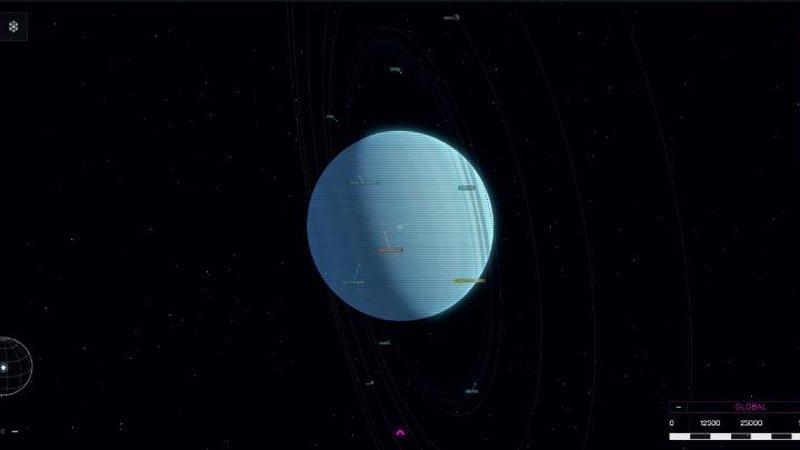
See the 98° tilt that puts Uranus's poles where other planets have their equators.
18 mapped features on the moon with the patchwork, fractured surface.
26 and 18 mapped features on the brightest and largest moons.
13, 10 and 3 mapped features.
Everything we know of these moons' surfaces comes from one flyby, Voyager 2's in 1986. The viewer puts those maps in their orbital context, with each named canyon and crater clickable.
Ariel, Miranda, Titania, Umbriel, Oberon and Puck.
Yes, in the browser, with no account.
Data: Voyager 2 imagery; IAU Gazetteer of Planetary Nomenclature. Every layer carries its source and licence in the GeoHUB legend; see Data Sources.
Explore Neptune in 3D with its storms and its largest moon, Triton, and Triton's 64 mapped surface features — free in your browser.
Explore Saturn in 3D: its rings and nine moons — Titan, Enceladus, Rhea, Iapetus and more — each with its mapped surface features, free in your browser.
Explore Jupiter in 3D with its cloud bands and its moon system: Io, Europa, Ganymede, Callisto and Amalthea, each with its mapped surface features — free in your browser.