GeoID Signal
A seismic centre and a volcano watch, free for everyone. Earthquakes and volcanoes as the agencies report them, with the source named on every item. Signal does not issue warnings.
A seismic centre and a volcano watch
Signal joins volcanoes, their cameras, earthquakes, seismograms and world events by place. It shows what each source publishes, with its timestamp. It issues no warnings of its own.
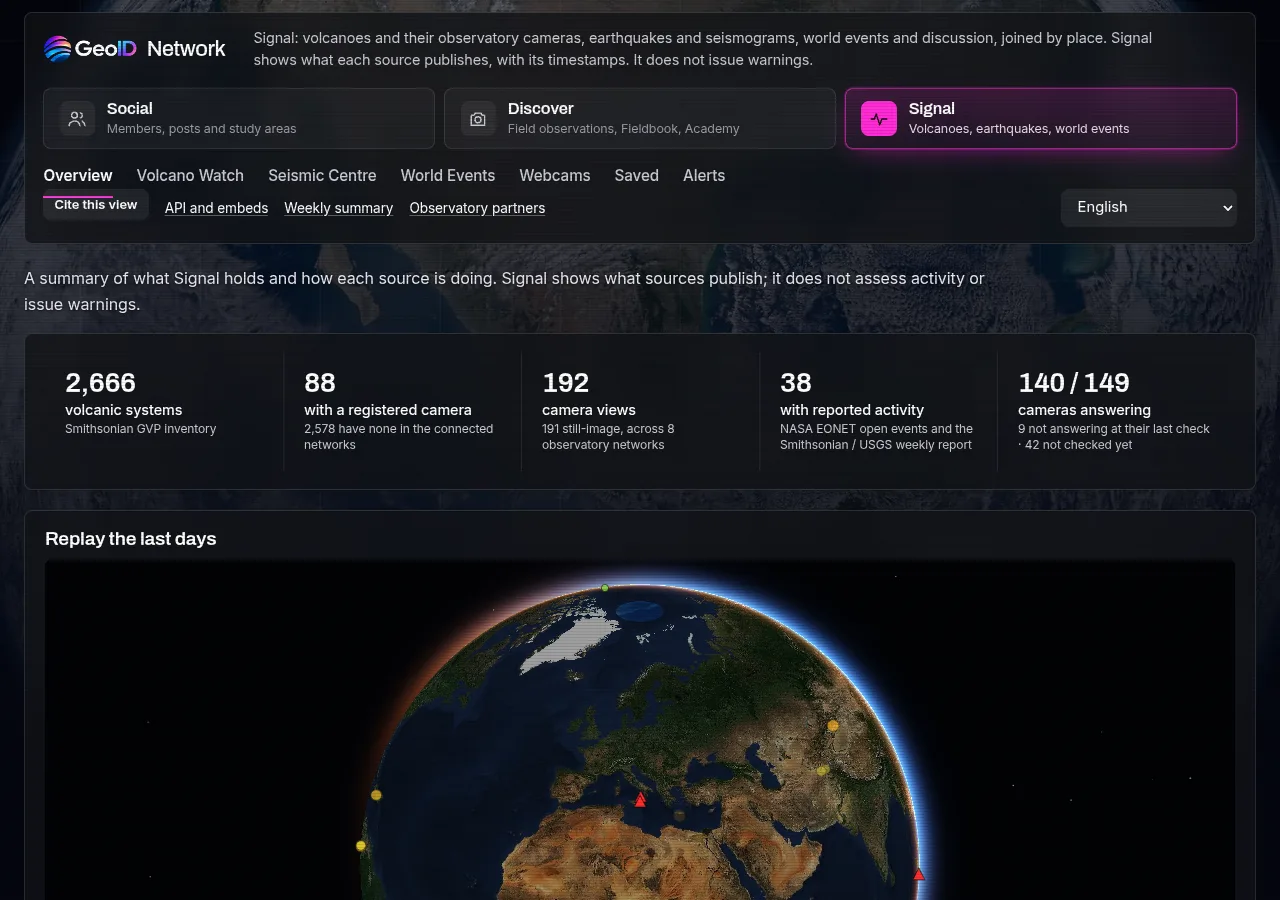
- 2,666
- volcanic systems from the Smithsonian GVP (v. 5.4.0)
- 192
- camera views at 88 volcanoes, from 8 observatory networks
- 3
- seismic agencies: USGS, BGS and GeoNet
- 8
- languages, from English to Japanese
- Seismic centre. Each agency’s report keeps its own id and status. A waveform lab opens from any earthquake. Tsunami messages and the nearest DART buoys sit beside it.
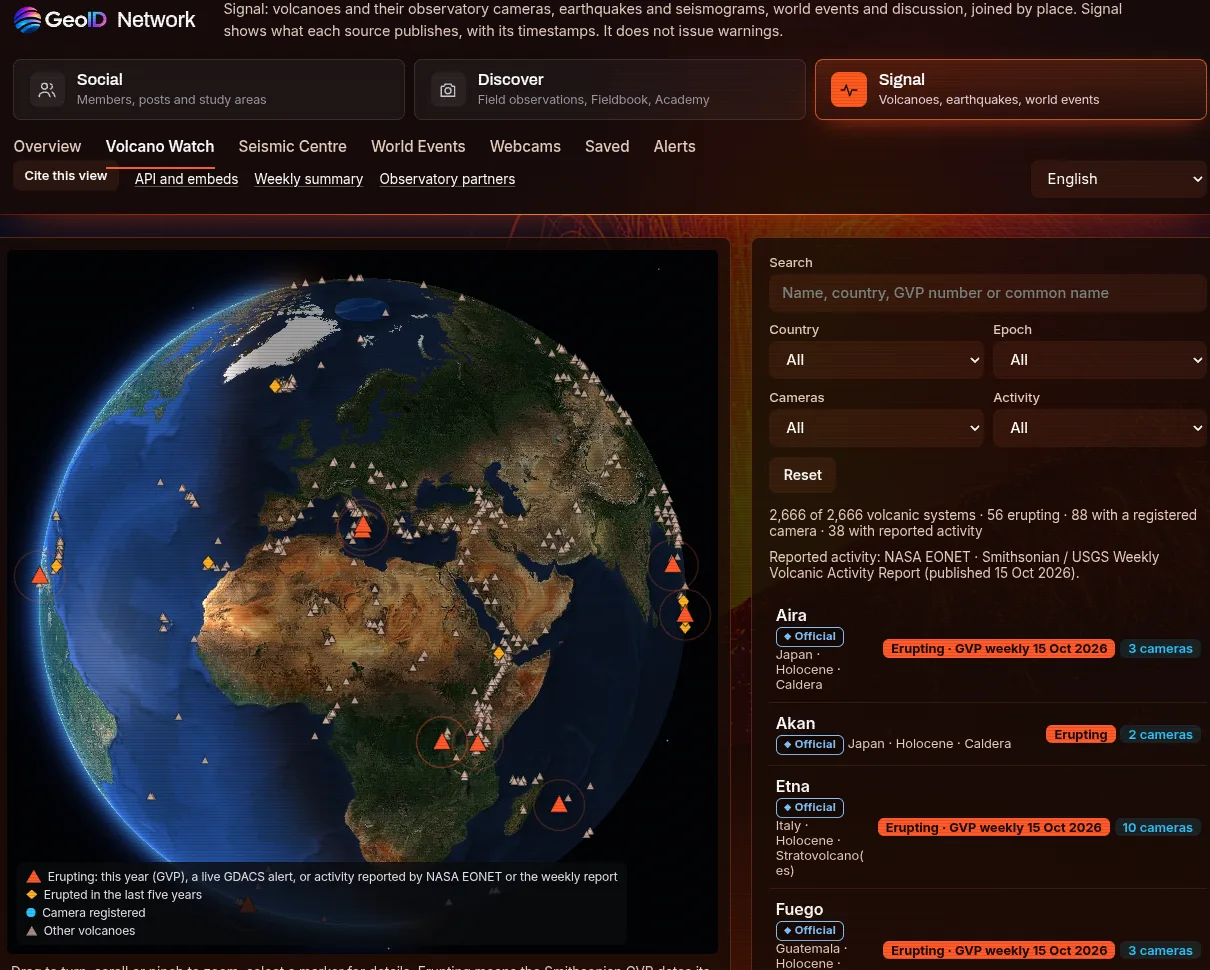
- Volcano watch. Filter every Holocene system by country, epoch, cameras and activity. Erupting means this year in GVP, a live GDACS alert, or activity in NASA EONET or the weekly report.
- Swarms counted, not forecast. A badge appears when this week’s earthquakes within 20 km of a volcano reach at least 10, and three times the usual rate.
- Official words, linked. National alert feeds for the United States, Canada, the Philippines, New Zealand, Italy and Iceland, each with its source.
- Your watchlist. Watch a volcano, a place or a study area. Alerts land in your inbox, with quiet hours.
- Built to share. A weekly summary each Monday, a public API, embeds for schools and observatories, and a citation for every view.
Volcanoes: Global Volcanism Program, Smithsonian Institution, Volcanoes of the World v. 5.4.0. Earthquakes: USGS, BGS, GeoNet. Imagery: Sentinel-2 cloudless 2025 by EOX IT Services GmbH.
Signal in depth
Six parts, each with its sources named. Signal is part of the Network, beside Social and Discovery. GeoHUB opens the same pages over the globe.
Seismic centre
Each earthquake is one record, however many agencies report it: USGS, BGS and GeoNet. A magnitude is never shown alone. A table lists each agency’s magnitude, depth, origin time and status.
USGS adds ShakeMap, Did You Feel It?, PAGER, the tsunami flag and the moment tensor. A swarm badge compares 7 days against 90. A catalogue explorer gives the Aki b-value and the magnitude of completeness.
Seismograms
The trace comes from GEOFON, ORFEUS (EIDA) or EarthScope. The waveform lab checks the miniSEED and removes the station response. It detrends, tapers, band-passes and draws a spectrogram, up to 1,800 s.
Raw counts are never called ground motion. A “Felt it?” button opens a felt report in Discovery, beside the USGS link.
Volcano watch
Activity comes from NASA EONET and the Smithsonian/USGS Weekly Volcanic Activity Report. Signal matches it by GVP number, then name, then the nearest volcano within 15 km.
Each volcano’s drawer groups ash, heat and gas (VAAC advisories, NASA FIRMS, SO₂), deformation (GNSS and InSAR) and history (GVP eruptions by VEI). It also shows national CAP alerts, and links to COMET and MIROVA.
Webcams and replay
Observatory cameras from JMA (94), the Alaska Volcano Observatory (50), INGV Osservatorio Etneo (17), GeoNet (11), OVSICORI-UNA (8), PHIVOLCS (7), INSIVUMEH (4) and the Yellowstone Volcano Observatory (1).
Each refreshes at its provider’s rate, every 1 to 10 minutes, through GeoID’s relay. The relay credits the observatory and keeps a 24-hour time-lapse. Replay plays the last 7 or 30 days of M2.5+ earthquakes and volcanic activity.
Watchlist alerts
Watch a volcano, or add a place by coordinates with a radius and a minimum magnitude. Signal checks its sources every 10 minutes: USGS earthquakes from M2.5, EONET, the weekly report, GDACS orange and red alerts, and the camera relay.
Alerts land in your inbox, with quiet hours and a weekly digest each Monday. Watching needs a GeoID account. Push and email are not switched on yet.
Embeds, API and the weekly report
Any site can embed a volcano card or a camera with one script tag. The public API needs no key and allows 120 requests a minute. It returns only official and instrumental items.
Each Monday, Signal writes a summary of the past week from the USGS catalogue, the GVP report and EONET. Observatories can join the partner programme for a badge and an uptime dashboard.
Public API, base https://signal.origingeospatial.com/api/v1
| Endpoint | Returns |
|---|---|
| GET /volcanoes | Every volcano with reported activity, matched by GVP number |
| GET /volcanoes/{gvp} | One volcano: activity items, cameras and sources |
| GET /earthquakes?window=hour|day|week&minmag=all|1.0|2.5|4.5|significant | Earthquakes in a window, above a magnitude |
| GET /cameras | Every registered camera, with health and uptime over up to 144 checks |
Photo credits
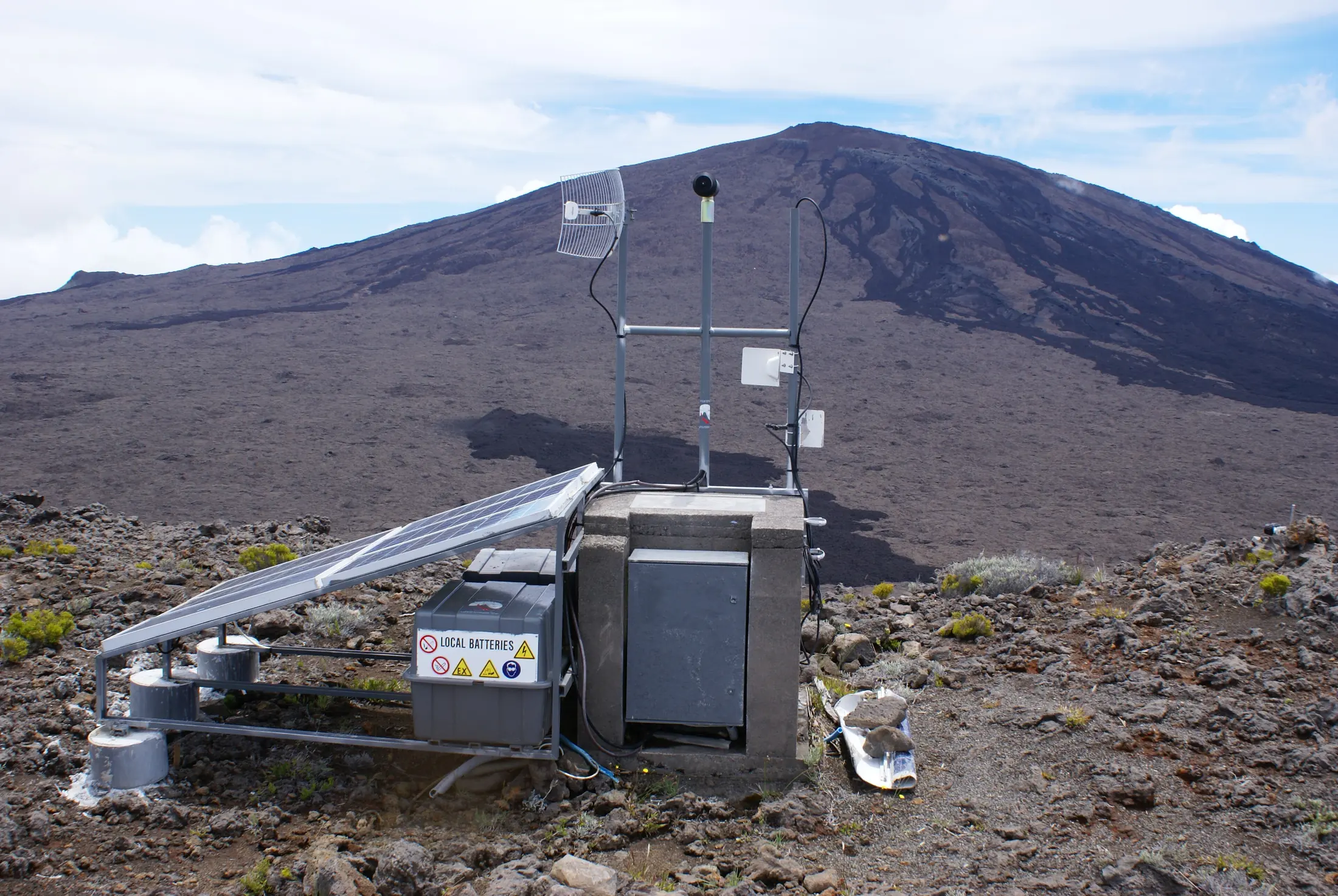
- ReunionFournaise GPSMonitoringStation · B.navez · CC BY-SA 3.0
- Photographs resized and cropped for this page; licences as listed on each Wikimedia Commons file page.