Jupiter in 3D
The largest planet and its moons in one view: Jupiter's cloud bands, and Io, Europa, Ganymede, Callisto and Amalthea in their orbits, each opening onto its surface with the features named.
The largest planet and its moons in one view: Jupiter's cloud bands, and Io, Europa, Ganymede, Callisto and Amalthea in their orbits, each opening onto its surface with the features named.
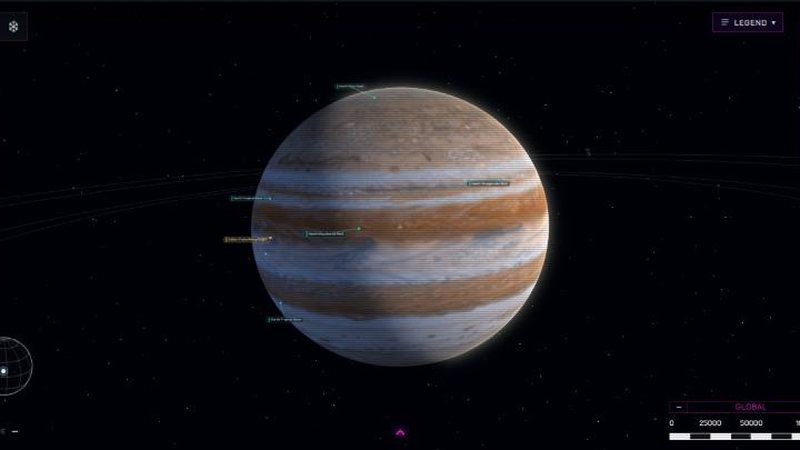
Watch the Galilean moons circle the planet, then open any of them.
254 mapped features on the most volcanic body in the Solar System.
130 features on the ice shell over a subsurface ocean.
203 and 155 mapped features on the two largest moons.
Each moon opens in its own view with its IAU-named features clickable: Io's volcanic centres, Europa's lines and chaos terrain, Ganymede's grooved terrain and Callisto's ancient, cratered surface — Amalthea too.
Io, Europa, Ganymede, Callisto and Amalthea, each with its mapped features.
Yes, in the browser, with no account.
Data: Mission imagery of Jupiter and its moons; IAU Gazetteer of Planetary Nomenclature. Every layer carries its source and licence in the GeoHUB legend; see Data Sources.
Explore Saturn in 3D: its rings and nine moons — Titan, Enceladus, Rhea, Iapetus and more — each with its mapped surface features, free in your browser.
Explore Uranus in 3D: the tilted planet and six moons — Ariel, Miranda, Titania, Umbriel, Oberon and Puck — with their mapped surface features, free in your browser.
Explore Neptune in 3D with its storms and its largest moon, Triton, and Triton's 64 mapped surface features — free in your browser.