Neptune in 3D
The outermost giant, with Triton — a captured world orbiting backwards, its surface mapped by Voyager 2. Explore the planet, then open Triton onto its 64 named features.
The outermost giant, with Triton — a captured world orbiting backwards, its surface mapped by Voyager 2. Explore the planet, then open Triton onto its 64 named features.
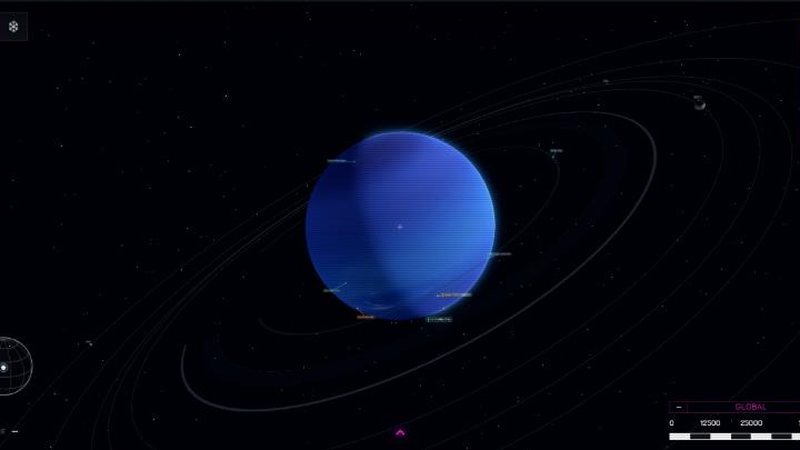
The deep-blue ice giant and its storms.
64 mapped features on the moon with nitrogen geysers and cantaloupe terrain.
Triton in its retrograde orbit, in the context of the planet.
Nothing to install.
Triton is thought to be a captured dwarf planet from the Kuiper Belt, and it is one of the few moons known to be geologically active. Its named features — plains, ridges and the dark streaks left by geysers — are clickable in the viewer.
Neptune and its moon Triton, with Triton's 64 mapped features.
Yes, in the browser, with no account.
Data: Voyager 2 imagery; IAU Gazetteer of Planetary Nomenclature. Every layer carries its source and licence in the GeoHUB legend; see Data Sources.
Explore Uranus in 3D: the tilted planet and six moons — Ariel, Miranda, Titania, Umbriel, Oberon and Puck — with their mapped surface features, free in your browser.
Explore Pluto in 3D from NASA New Horizons: the nitrogen-ice heart, the mountains, and the Pluto–Charon binary in one view — free in your browser.
Explore Saturn in 3D: its rings and nine moons — Titan, Enceladus, Rhea, Iapetus and more — each with its mapped surface features, free in your browser.