Mercury in 3D
Spin, zoom and explore the innermost planet on the global mosaic NASA's MESSENGER spacecraft returned from orbit, with its named craters, basins and the long lobate scarps left as Mercury cooled and shrank.
Spin, zoom and explore the innermost planet on the global mosaic NASA's MESSENGER spacecraft returned from orbit, with its named craters, basins and the long lobate scarps left as Mercury cooled and shrank.
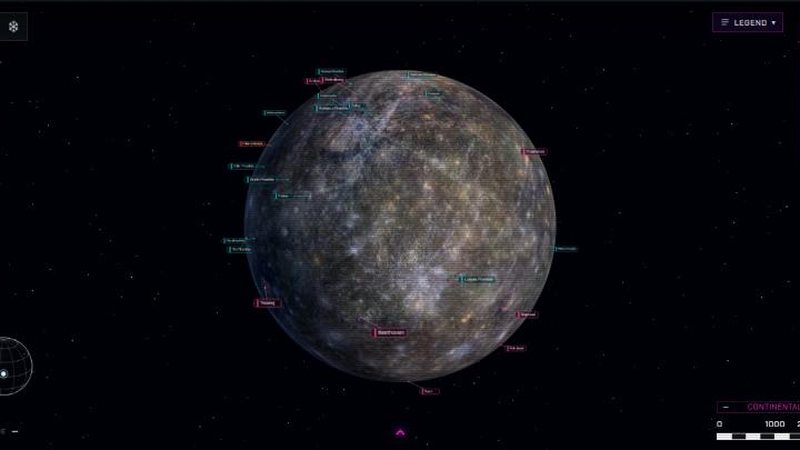
The whole planet from the first spacecraft to orbit it.
Search the IAU-recognised craters, basins and scarps and fly straight to them.
Draw a line across a basin rim and read its relief.
Slice the planet open to its outsized iron core.
Mercury's scarps run for hundreds of kilometres: cliffs pushed up as the planet's interior cooled and its crust contracted. In the viewer they are named and clickable, beside the great Caloris basin and the craters that cover the rest of the surface.
NASA MESSENGER's global mosaic, with IAU-recognised feature names.
Yes — it runs in the browser, with nothing to install and no account.
Data: NASA MESSENGER global mosaic; IAU Gazetteer of Planetary Nomenclature. Every layer carries its source and licence in the GeoHUB legend; see Data Sources.
Explore the surface of Venus in 3D from NASA Magellan radar: volcanic plains, coronae and the deformed highlands under the cloud deck — free in your browser.
Explore the Moon in 3D: LROC imagery over LOLA relief, 2,087 named features, the USGS geologic map with 12,000+ clickable units, and a core cutaway — free in your browser.
Explore Mars in 3D on NASA MOLA relief with the CTX image mosaic, mapped geology, named features and a flight simulator — free in your browser.